
Intro to SE4N
Fiscal

Yes, a governing body of the organization must vote to accept (approve) or not accept (not approve) the final audit reports received from the auditors. This is not only a generally accepted best practice but also a compliance requirement because the audit reports and the auditing process will be considered incomplete unless the independent auditors receive formal approval notice from the governing body of the organization.

Establishing operating and intermediate cash management target policies will provide many benefits. This simple but often overlooked cash management best practice will augment internal accounting controls, boost cash management awareness, and enhance perceptions that nonprofit organization management systems are significant and robust.

Audit findings are not unusual. Most nonprofit organizations will have many more years with audit findings reported by their auditors than years for which there are no findings. Audit findings tend to produce feelings of negativity and thoughts that something is wrong. Adding thoughtful written management responses will turn negative feelings into positive and constructive actions

An organization’s Form 990 is universally recognized as a key source of information by the general public, including constituents, donors, grantors, sponsors, and governments. Yet, I often feel that many nonprofits are not paying enough attention to whether the Form 990 adequately tells the complete story about how hard they work to fulfill their mission.

The purpose of the funding pipeline worksheet is to help your organization conduct regular periodic assessments of funding and revenue streams, consider changes to anticipated and past funding patterns, and assess whether there is a risk that budgeted funding might not be realized in the near-term and intermediate-term future. Complete this worksheet in collaboration with your development office, senior management team, and staff to help with operational planning and stress test your organization’s anticipated funding sources.

SE4N's A. Michael Gellman provides a short lesson on how to approach drafting a nonprofit organization's mission statement and description for the three different parts of the Form 990.
Financial

Just as the gauges on a car’s dashboard provide crucial information about its performance and physical condition, operating reserves serve as a vital indicator of a nonprofit organization’s financial health and as a measure of stability. Operating reserves give a clear view of an organization’s capacity to sustain its operations and weather financial uncertainties. By understanding and managing operating reserves, nonprofit leaders can navigate their organizations toward greater longevity and stability, ensuring they remain trusted and impactful stewards of their missions for years to come.
Monthly distribution of financial reports to the Board and finance committee is absolutely a best practice for nonprofit organizations, and I also recommend this as a must-have procedure in your accounting policies and procedures manual. Board and finance committee members have a fiduciary responsibility to help oversee and ensure the safety and proper use of a nonprofit organization’s financial assets. Monthly financial reports are a key tool for fulfilling this important role.

The delivery and interpretation of financial reports is a complex and sometimes unpredictable process. It becomes even more complicated when you realize that the target audience consists of multiple end-users who will be considering financial information from multiple points of view. Effective financial messaging tactics that incorporate a three-dimensional (3-D) tactical approach will give you more options and opportunities to connect with the many different types of users of financial information.
The answer is always yes, keeping track of donated services is very important. You are correct that the Form 990 does not allow inclusion of in-kind gifts of services (only in-kind gifts of goods). Nonetheless, tracking and recording in-kind gifts of services will have significant benefits for your organization.

Operating reserves are one the most important components of financial health for a nonprofit organization and a key indicator for long-term fiscal and financial sustainability. Providing regular reports on the status of an organization’s operating reserves is essential for monitoring an organization’s financial health as well as compliance with its operating reserve policy.
SE4N's A. Michael Gellman provides a short summary of the definition of a prepaid expense, how prepaid expenses show up on the balance sheet, and how prepaid expenses impact the operations of #nonprofit organizations.
Legal

501(c)(3) nonprofit organizations rightfully focus much of their attention on complying with laws involving conflicts of interest among Board members, officers, and management. However, the “private benefit rule” is often overlooked and reaches far beyond an organization’s insiders. A basic understanding of the private benefit rule can help you navigate potential issues in a wide variety of programs and activities.

Business or “fee-for-service” revenue can be an important source of unrestricted funds for a well-rounded nonprofit organization. However, many organizations are hesitant to engage in commercial activities due to worries about the unrelated business income tax (“UBIT”). A basic understanding of UBIT fundamentals can alleviate these fears and help organizations to make better, more confident decisions about their business activities.
Extended family members such as aunts, uncles, and cousins generally fall outside of the technical definition of “family members” under the federal tax code provisions governing conflicts of interest involving 501(c)(3) nonprofit organizations. However, these types of relationships can certainly lead to the perception that there is a conflict and should be treated as such to avoid the risk of damaging your organization’s reputation.

I often receive inquiries from entrepreneurs who are looking to add a philanthropic component to an existing for-profit business, such as by forming a nonprofit as a charitable arm or subsidiary of their business or starting a corporate foundation. These ideas are usually well-intentioned. However, mixing business and charitable activities too closely can make IRS approval of 501(c)(3) status an uphill battle.
![TEMPLATE: Independent Contractor Agreement [SUBSCRIBERS-ONLY]](https://images.squarespace-cdn.com/content/v1/5e6ccadfb4659c1d51df14d5/9c548fca-b5f0-4ea1-8837-07d3ef70c66a/glenn-carstens-peters-ARpAUafeTp0-unsplash.jpg)
This independent contractor agreement template contains basic provisions for situations in which nonprofit organizations hire consultants and other service providers on an independent contractor (Form 1099) basis. The template includes language intended to help support independent contractor treatment when appropriate, and covers key terms such as confidentiality, intellectual property rights, insurance, indemnification, and more.

SE4N's Benjamin Takis provides a short lesson on how to properly draft and maintain nonprofit Board and committee meeting minutes.
Governance

All nonprofit organizations should regularly review and assess their Bylaws to ensure this key governing document complies with the law and is optimally aligned with the organization’s governance needs and operational practices. The following are five common Bylaws oversights to look for when doing your organization’s next Bylaws review.
Executive Committees are often granted wide-ranging authority to the to act on behalf of a nonprofit organization and exercise the powers of the Board of Directors in between Board meetings. Absent additional, clarifying language in the Bylaws, committee charter, or Board resolutions, there are generally few legal limitations on an Executive Committee’s authority. However, there are some explicit and implicit limits that are important to consider

The concept of a “Board champion” for a nonprofit organization is frequently misunderstood. Board champions do not necessarily have to be officers. They can be any responsible Board member who is willing and able to actively engage in helping the organization. Board members have the potential to help in many ways, both small and large, by sharing their experiences, skills, and aspirations for the organization. Even seemingly small ideas and offers to assist can sometimes have just as big of an impact as officer service.

I have looked at many lists of Past Presidents for nonprofit organizations and been amazed by the roster of names, but I am often disappointed at how many Past Presidents have become lost connections. High performing nonprofits keep their Past Presidents engaged and connected with meaningful active roles that are thoughtful and strategic.
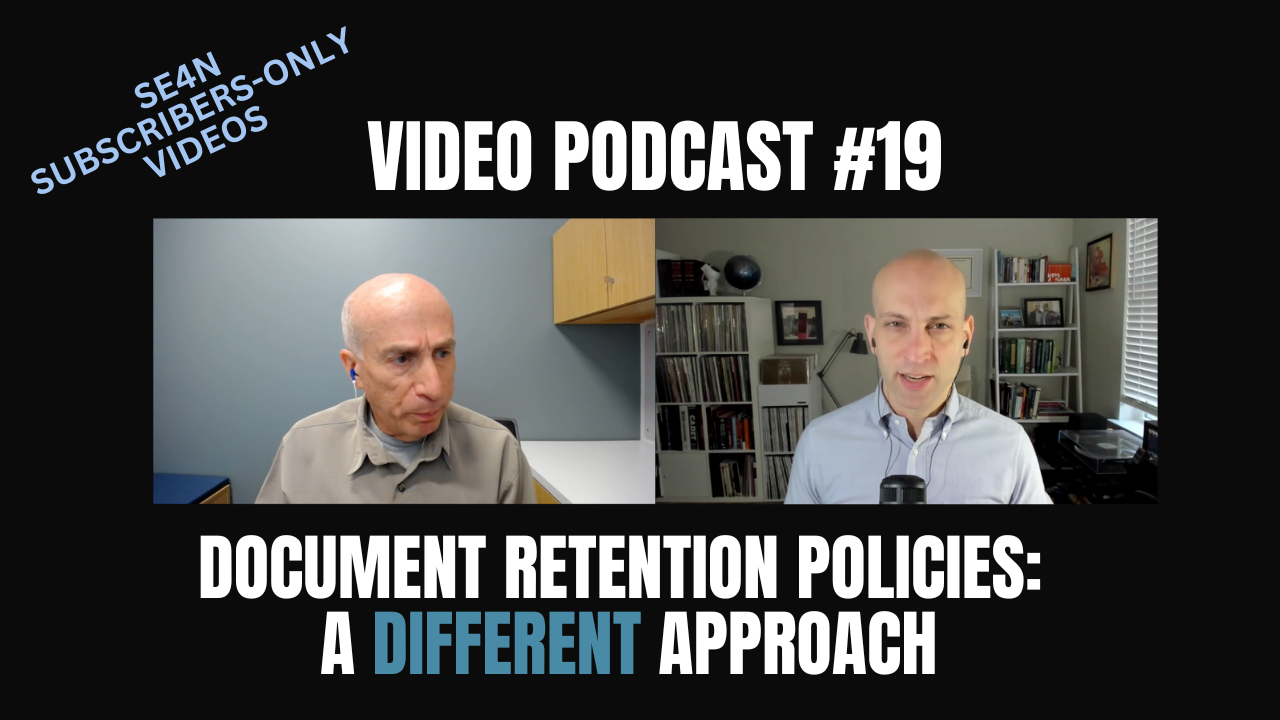
Ben and Mike discuss document retention and destruction policies, the reasons why many common basic templates are very burdensome and lead to inconsistent implementation and other problems, the different approach we use in our policy template, considerations relating to electronic storage, and more.

A Code of Ethics is one of the fundamental governance policies that all nonprofit organizations should have, and an important complement to your organization’s conflict of interest policy. This Code of Ethics template is intended to help your organization identify and express the core principles and ethical requirements with which all Board members, staff, and other individuals who serve and/or represent the organization are expected to comply.